
Casita Two Bedroom vs Flip Lite
Casita Two Bedroom is the safer buy if you need a permitted, financeable dwelling; the Flip Lite competes on price, format or speed, not on a certification a planning department will accept.
Casita Two Bedroom
Boxabl's largest current production model: two Casita modules joined with a laundry room vestibule to create a 722 sq ft, two-bedroom, one-bathroom home. At $110K unit-only or $210K turnkey, it targets families, multigenerational households, and ADU investors seeking California-compliant two-bedroom rental income. The first Boxabl model to receive California statewide approval (November 2025), and the most spacious unit Boxabl currently ships.
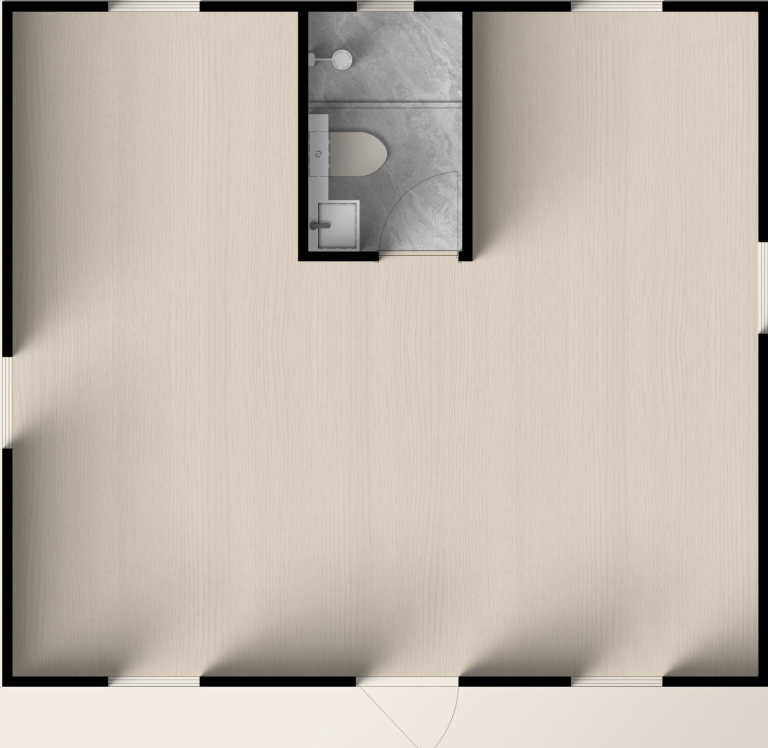
Flip Lite
A US-sold folding unit with an unusually transparent price ($44,600) and published wind, seismic and fire ratings — though no certification seal to back a permit.
Which one wins
Flip Lite is the lower delivered cost ($55,000 – $85,000 versus $140,000 – $250,000 — roughly $125,000 apart at the midpoint). Remember both figures are estimates that already fold in freight, site work and hookups, not base prices. Casita Two Bedroom gives you more deployed floor area at 722 sq ft — well over the Flip Lite's 455 sq ft. Casita Two Bedroom carries the stronger certification position (state modular seal), which is what decides financing, insurance and whether a county will permit it as a dwelling; the Flip Lite is uncertified, so treat it as a portable building until your jurisdiction says otherwise. Some specifications on this page are projected rather than confirmed by the manufacturer — check the badges before relying on a number.
Full spec comparison
| Specification | Casita Two Bedroom | Flip Lite |
|---|---|---|
| Maker | Boxabl | PackPrefab |
| Category | Foldable | Foldable |
| Status | Shipping | Shipping |
| Base priceProjected / Unconfirmed | $110,000 | $44,600 |
| Estimated delivered costProjected / Unconfirmed | $140,000 – $250,000 | $55,000 – $85,000 |
| Deployed areaProjected / Unconfirmed | 722 sq ft | 455 sq ft |
| Bedrooms | 2 | 1 |
| Bathrooms | 1 | 1 |
| Folded dimensionsProjected / Unconfirmed | Two folded Casita modules plus a laundry room vestibule, transported on separate flatbeds; each module approximately 8.5 ft W × 19 ft L × 12 ft 4 in H (highway-legal width) | 19 ft 7 in L × ~7 ft 7 in–8 ft W × 8 ft 4 in–9 ft 6 in H |
| Deployed dimensionsProjected / Unconfirmed | 19 ft × 38 ft footprint, 9.5 ft ceilings | 19 ft 7 in × ~22–23 ft, about 430–455 sq ft |
| Setup timeProjected / Unconfirmed | Two modules delivered, vestibule inserted and joined on-site; estimated ~1 day for the mechanical assembly; utility connections, inspection and permits add additional time | About 8 hours with two workers |
| Foundation | Permanent foundation required (poured concrete pad, engineered piers or slab) for the 19 ft × 38 ft joined footprint; crane access required at both ends of the site | Level pad; no permanent foundation specified |
| Certifications | State modular seal | No certification verified |
| Regions served | United States — California statewide approval received November 2025 (first Boxabl model to receive CA statewide approval, per PRNewswire Dec 17, 2025). Orders accepted for all 50 states; availability in other states subject to individual state approval review. Shipping $8–$15/mi from North Las Vegas. | United States (Texas metros confirmed; wider US shipping likely but unverified) |
| Lead timeProjected / Unconfirmed | Boxabl cites production in as little as ~2 months; $250 order fee + $2,500 deposit to begin purchase process. Order-to-delivery timelines historically variable. | Not published |
| Financing | Boxabl cites ~$1,200/mo financed. Carries a state modular seal (not a HUD label); expect construction-to-permanent loans, home equity products, or personal loans as most common financing paths. Conventional mortgage applicable if permanently affixed and titled as real property. | Not published; retail purchase. |
| Warranty | 1-year manufacturer warranty plus 6-year extended warranty (per Boxabl product page, Nov 2026) | Not published |
| Best for | ADU / backyard home, Primary residence, Rental investment | ADU / backyard home, Hospitality & short stay, Rental investment, Jobsite & workforce |
Who should buy the Casita Two Bedroom
Buy the Casita Two Bedroom if you want a permitted, financeable dwelling and can budget the full delivered cost rather than the base price — it is the side of this comparison a lender and an appraiser will recognise.
- • Two genuine bedrooms — suitable for families, multigenerational use, or two-occupant rental at higher California ADU rents
- • California statewide approval received November 2025 — the first Boxabl product to achieve this milestone
- • Factory-installed full kitchen, full bathroom, laundry room vestibule, HVAC, electrical and plumbing across both modules
Who should buy the Flip Lite
Buy the Flip Lite if you need working space fast — jobsite offices, crew quarters or temporary commercial use, and want the cheaper of the two — and permanent-dwelling certification is not part of the plan.
- • Rare transparent, published pricing from a US seller
- • Concrete engineering ratings quoted (156 mph wind, seismic Cat E/F, 1-hour fire)
- • Fast two-person, ~8-hour setup
Questions people ask about this comparison
- How much does a Boxabl actually cost delivered?
- The Casita's base price is around $60,000. A realistic delivered-and-installed figure in the US is $95,000 to $140,000 once you add freight, crane, site work, an engineered pad, utility connections and permits. On raw land with no services, the top of that range is the honest planning number. Anyone quoting you a turnkey Casita at the base price is leaving something out.
- What is the cheapest foldable home you can actually buy?
- Expandable container buildings sell in the US from roughly $20,000 on marketplaces, and brand-name US sellers like Chery Industrial now start closer to $30,000, sometimes available from stock. They are legitimate portable buildings — excellent jobsite offices, studios and farm structures. They are not certified dwellings in most counties, so if your plan is to live in one full-time on a permitted lot, the real cheapest option is a certified unit at two to three times that price.
- Are the expandable container homes on Amazon any good?
- As portable buildings, some are perfectly fine — a galvanized-steel frame with foam-panel walls that unfolds into 380–800 sq ft for a low price, useful as an office, studio, guest room or short-stay unit. As dwellings, they are a problem: none of the Amazon-sold units in our catalog (Feekercn, EROMMY) carries a verified residential certification, so most jurisdictions will not permit them as a residence, and warranty and support are retail-grade. Buy one for what it is, plan for import logistics and an electrician, and do not mistake a low sticker price for a low-cost home.
- Can I put a foldable home on raw land?
- Physically yes, but the site work is where the budget goes. Raw land with no services means you pay for access, clearing and grading, a foundation, and — the big one — utilities, where a septic system alone can exceed $20,000. On the cheapest units the site work frequently costs more than the building. Plan on roughly base price × 2.2 for an unserviced site, and confirm your parcel is zoned for a dwelling and can pass a septic/perc test before you buy either the land or the unit.
- What is the Boxabl Baby Box?
- A small towable Boxabl launched around $19,999, with a wet bath and kitchenette in roughly 120 sq ft, aimed at offices, studios and guest rooms rather than full dwellings. It is SUV-towable and off-grid capable, but it is RV-classed rather than a permitted dwelling, and several specs — folded dimensions, certification and warranty — remain unconfirmed by Boxabl. Treat it as a preorder with projected numbers, not a shipping product you can pin down today.
- Are foldable homes legal in California?
- Yes, if the unit carries the right certification. California permits factory-built housing with a state modular (HCD) insignia or a HUD label on a compliant foundation, and state ADU law is unusually friendly to accessory units. What California does not permit is an uncertified imported container building used as a dwelling. The certification label, not the folding mechanism, decides the answer.